
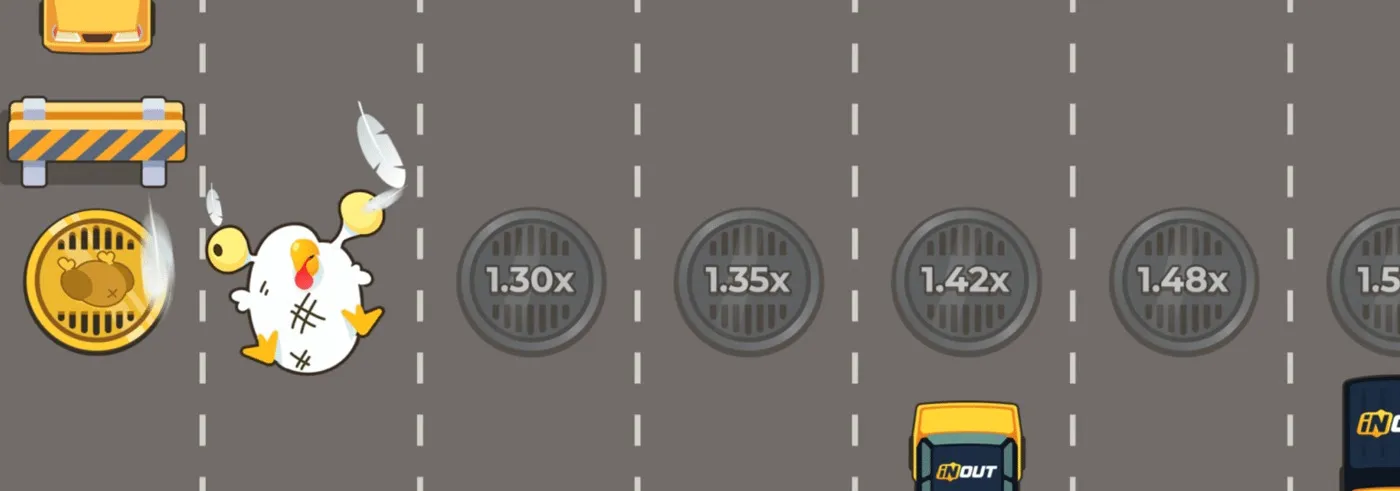
A cartoon chicken, a road full of traffic and a number that grows with every hop - this sums up the Chicken Road game from InOut Games. You never spin reels and never watch a line climb on its own. Instead, you decide each step yourself and choose the moment to stop, which makes the title feel closer to a board game than to a classic slot.
This page explains Chicken Road play from the inside: what every part of the screen does, how a single round unfolds, how the multiplier is built and why so many promises around the game are false. It also sets out the legal picture for readers in India, where money gaming is no longer allowed.
Play NowPlay (opens in a new tab)
What Kind of Game Chicken Road Is
InOut Games lists the title on its own catalogue page with a release date of 4 April 2024, an RTP of 98% and a single-player format. The single-player detail matters: unlike shared crash games, where a whole lobby watches one rocket, here each person walks a separate chicken, and the result of your round has nothing to do with anyone else on the platform.
The developer sums up the tension in one line on the game page: the further the bird travels, the bigger the reward and the greater the chance of being fried. Everything else on screen exists to make that one trade-off visible. InOut later built a sequel called Chicken Road 2.0, but this guide deals only with the original.
Why People Call It a Crash Game
Industry databases put the title in the crash category because a round can end abruptly at any step and the stake is lost when it does. The difference is control over pace. A rocket keeps flying while you hesitate, whereas the chicken waits patiently until you press the button again. The name is often written without a space, as ChickenRoad, and a search for ChickenRoad play returns the original alongside look-alike titles, so it pays to check the InOut logo inside the game.
Reading the Screen and Playing a Round
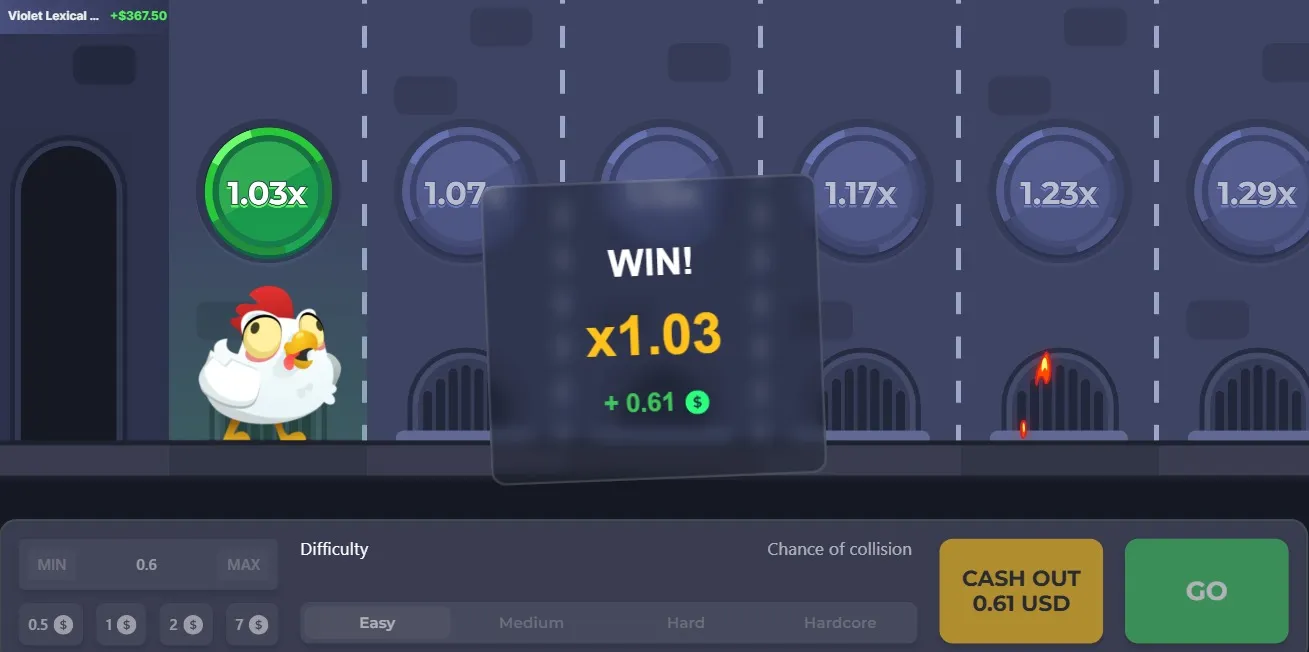
When ChickenRoad online loads in a browser, the layout is the same on a laptop and on a phone. The road takes up most of the view, and a control panel sits along the bottom edge. Before the first move it helps to know what each element is for:
• the stake field with MIN and MAX buttons, plus quick chips for common amounts
• the Difficulty switch with four positions, from Easy on the left to Hardcore on the right
• a label showing the chance of collision for the mode you have picked
• the green Go button that moves the chicken one lane forward
• the yellow Cash Out button, which shows the amount you would lock in right now
Many builds also show a feed of other people’s recent results along the top. It is decoration and says nothing about your next step, so keep your eyes on the two buttons that matter.
One Round From Start to Finish
A typical round of Chicken Road play takes well under a minute. Seen as a sequence, it looks like this:
1. Set the stake in the panel and choose a difficulty before pressing anything else.
2. Press Go once and the chicken hops onto the first manhole cover in lane one.
3. If no car hits it, the cover turns green and shows the multiplier you have reached.
4. Press Go again to risk that amount on the next lane, or press Cash Out to keep it.
5. If a car arrives first, the round ends at once and the stake for that round is gone.
Notice that there is no point at which the game forces you to stop, except for the final lane of each mode. The whole skill, if you can call it that, lies in discipline: deciding before the round where you will press Cash Out and then actually doing it.
How the Multiplier Grows Lane by Lane
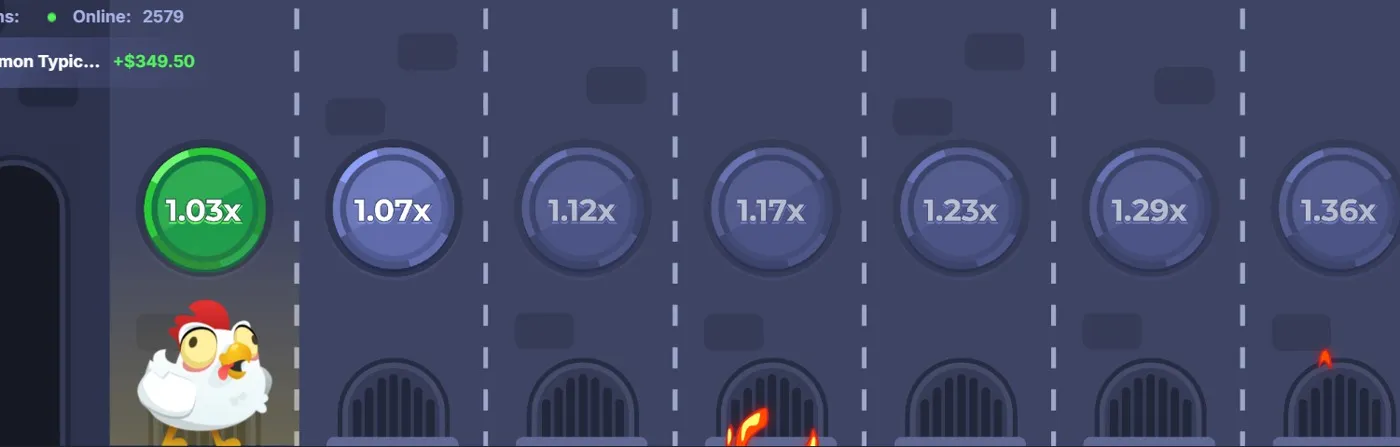
Each manhole cover carries a number, and that number is the multiplier applied to your stake if you stop there. The steps start small. In the Easy build shown in our screenshot, the first seven covers read 1.03x, 1.07x, 1.12x, 1.17x, 1.23x, 1.29x and 1.36x. The table turns the first six into rupees on a stake of INR 100, purely as an illustration of the arithmetic:
| Lane | Multiplier on Easy | Value of an INR 100 stake | Gain over the stake |
|---|---|---|---|
| 1 | 1.03x | INR 103 | INR 3 |
| 2 | 1.07x | INR 107 | INR 7 |
| 3 | 1.12x | INR 112 | INR 12 |
| 4 | 1.17x | INR 117 | INR 17 |
| 5 | 1.23x | INR 123 | INR 23 |
| 6 | 1.29x | INR 129 | INR 29 |
These rupee figures are a maths example and nothing more. Indian law now forbids staking real money on games like this, and this page does not invite anyone to place a stake. What the table does show is how slowly value builds on the gentlest mode: six safe steps add less than a third to the original amount, while one collision wipes out all of it.
What an RTP of 98% Really Means
Return to player describes the game’s behaviour over millions of rounds, and it says nothing reliable about one evening. A 98% figure means the game keeps about two units out of every hundred staked over that vast sample. In a short session results swing wildly in both directions, and the built-in edge only shows up once the sample is very large.
The Ceiling on Any Single Win
Game databases quote multipliers in the millions for a full Hardcore run, yet the payout itself is capped. SlotCatalog’s review gives the maximum prize as EUR 20,000 per round. In practice the giant figures on the last covers are there for show, not for planning a session around.
Hack, Predictor and Login Myths
Few titles attract as much misinformation as this one. Search for Chicken Road hack and you will find videos, channels and websites claiming to reveal the safe lanes in advance. The honest answer is short: there is no working Chicken Road hack. Reviews describe the game as provably fair, so the result of a round is fixed by a server seed before the chicken moves, and its hash can be checked afterwards. Nothing on your phone can read that seed early.
A related myth says that after a run of early collisions a long safe streak is due. That is the gambler’s fallacy. Each step is settled independently, so a crash in lane two tells you nothing about the next round, and no betting pattern changes the edge described above.
Chicken Road Login and Who Holds Your Account
The game itself has no user accounts. InOut supplies it to platforms, and any sign-in screen you see belongs to the site that hosts it, not to the developer. That is why a page offering a special Chicken Road login deserves suspicion. Look-alike portals copy the chicken artwork to collect phone numbers, passwords and payment details. Never enter personal data on a site that reached you through an advert or a chat message.
Chicken Road in India: Where the Law Stands
Anyone looking at Chicken Road in India needs to know that the rules changed in 2026. The Promotion and Regulation of Online Gaming Act, 2025 received presidential assent in August 2025, and the government brought it into force from 1 May 2026, together with the Online Gaming Rules, 2026. Online money games, whether based on chance, skill or a mix of both, are now prohibited.
The ban reaches further than the games. Advertising them is unlawful, and banks and payment services may not process transactions linked to them. A new regulator, the Online Gaming Authority of India, classifies titles and handles complaints. For readers here, Chicken Road online is something to understand, not something to stake rupees on.
Healthy Habits Around Any Game of Chance
Games built on risk are designed for adults, so this content is meant only for adults over 18. Keep sessions short, never treat a game as a way to earn money, and be wary of anyone who offers to teach a winning system for a fee. If thoughts about gaming start to push aside sleep, work, study or family, talk it over with a friend, a relative or a qualified counsellor.
Chicken Road Game Pros and Cons
Judged purely as a piece of game design, the title has clear strengths and some obvious weaknesses. Here is how they balance out.
| Pros | Cons |
|---|---|
| Rounds are fast and the rules fit on a single screen, so anyone can grasp the idea of hop, risk and cash out within a minute. | The quick rhythm makes it easy to play far more rounds than planned, and losses add up faster than the cheerful cartoon style suggests. |
| You control the pace of every step, which makes the link between risk and reward easy to see compared with automatic crash games. | The title attracts fake hacks, predictors and cloned login pages, so careless searching can lead to scams or stolen data. |
| The developer lists a 98% RTP, which is higher than the figures quoted for many reel-based slots and for the 2.0 sequel. |
Our Verdict on the Crossing Game
Chicken Road play boils down to one repeated choice: take the number on the cover or risk it on the next lane. The screen is tidy, the maths is easy to follow, and the provably fair setup leaves no room for the hacks sold around it.
For readers in India the bottom line is simple. Real-money Chicken Road play is outlawed, so treat this guide as an explanation of the mechanics, not as an invitation. Stay away from login portals and tools that promise sure wins, and keep any gaming short and strictly recreational.